
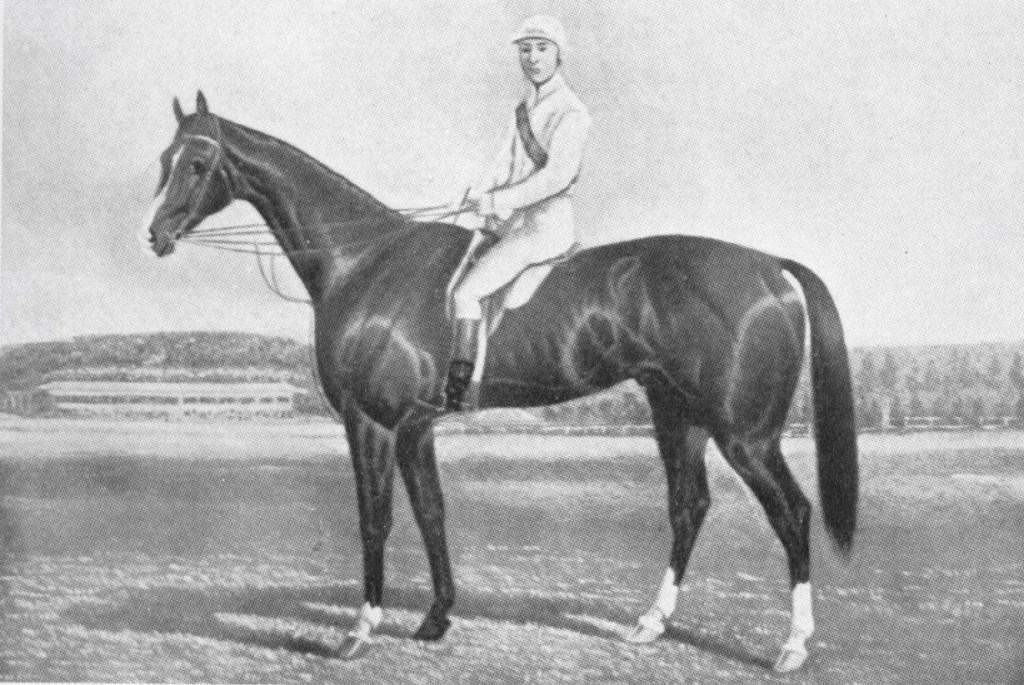
When Tasmanians think of Melbourne Cup-winning horses bred on the Apple Isle, most immediately think of Piping Lane, the 1972 champion. Yet almost 90 years earlier another Tasmanian-bred horse etched his name into Australian racing folklore.
His name was Malua.
Today, a statue of Malua proudly stands in Deloraine, reminding locals of one of the greatest racehorses this country has ever produced. Yet outside racing historians, few Australians know the extraordinary story of the little horse from Tasmania who became arguably the most versatile thoroughbred in Australian history.
A Champion No One Wanted
Malua was foaled at Calstock, near Deloraine, and was bred by John Field. As a two-year-old he raced in Tasmania under the name Bagot, winning races on three different Tasmanian tracks.
He was sold as a yearling to former Tasmanian Premier Thomas Reibey before eventually being purchased by Victorian owner John Ord Inglis for 500 guineas. Following the sale, Inglis renamed him Malua.
Ironically, when he arrived in Victoria, his new connections weren’t impressed.
Small, plain and rather scrubby looking, Malua was hardly the horse they had expected. His first nine starts in Victoria produced little to excite his owners, who questioned whether they had made a wise investment.
Little did they know they were about to own one of Australia’s greatest racehorses.
The Remarkable Year of 1884
The year 1884 is remembered for many historical events. It was the year Mark Twain published The Adventures of Huckleberry Finn and the year European powers met at the Berlin Conference to divide Africa.
It was also the year an unwanted Tasmanian horse rewrote Australian racing history.
Malua resumed racing in March by winning the prestigious Newmarket Handicap over six furlongs (1200 metres), one of Australia’s premier sprint races.
Just two weeks later he claimed another major sprint, the Oakleigh Plate over five furlongs (1000 metres).
Winning Australia’s biggest sprint double was remarkable enough.
But then came something almost unimaginable.
His next start was the Adelaide Cup, run over approximately 2600 metres.
He won that too.
Imagine a horse today winning the Newmarket Handicap, Oakleigh Plate and then stepping straight up to win the Adelaide Cup. It simply doesn’t happen.
Already, Malua was demonstrating a level of versatility the sport has rarely, if ever, seen.
A Spring Carnival Like No Other
Following his Adelaide Cup triumph, Malua was freshened for the Melbourne spring carnival.
His preparation included a trip to Sydney where he won the Spring Stakes over 2400 metres before finishing second in the Craven Plate over 2000 metres just five days later.
Two days after that he lined up again—this time over an astonishing 4800 metres—and finished second.
In the space of a week, Malua had raced over 2000 metres, 2400 metres and 4800 metres.
To put that into modern terms, it would be like a horse contesting the Caulfield Cup, Cox Plate and Grand Annual Steeplechase all within seven days.
It is almost impossible to imagine in today’s racing environment.
Melbourne Cup Glory
Malua arrived in Melbourne in peak condition and captured Australia’s greatest race, the 1884 Melbourne Cup.
Remarkably, his spring campaign didn’t stop there.
Two days after winning the Cup, he ran second over 1200 metres on Oaks Day.
Two days later he was back over two miles (3200 metres), again finishing second.
During Melbourne Cup week alone, Malua raced three times—twice over two miles and once over six furlongs.
It was a schedule that would be considered impossible today.
Throughout 1884 he won elite races over distances ranging from 1000 metres to 3200 metres, while also placing over 4800 metres.
No modern horse has come close to matching that extraordinary range.
Still Winning at Nine
After a deserved spell, Malua returned in 1885 to win the Australian Cup over 3600 metres.
Then his winning run dried up.
For three years he failed to win another race.
By August 1888, now a nine-year-old, most horses would have been comfortably retired.
Instead, Malua’s connections tried something completely different.
First-up after four months away from the track, he contested the Grand National Hurdle over three miles.
It was the only hurdle race of his career.
He won.
To this day, Malua remains the only Melbourne Cup winner to also claim a Grand National Hurdle, an extraordinary achievement that further cemented his reputation as Australia’s ultimate all-round racehorse.
He would race another 11 times before retirement, recording one further victory.
At stud
Malua sired 9 stakeswinners with 13 collective stakes wins including Malvolio, (1891 Melbourne Cup), Mora (VRC Melbourne Stakes, SAJC Adelaide Cup and VRC October Stakes) and Ingliston (1900 Caulfield Cup)
Tasmania’s Forgotten Champion
In an era where horses are carefully managed and often specialise over one distance, Malua’s record seems almost unbelievable.
He won Australia’s greatest sprint races, captured the Melbourne Cup, conquered staying contests, ran competitively over 4800 metres and even won a Grand National Hurdle.
Few, if any, racehorses in Australian history have demonstrated such incredible versatility.
Today his statue stands proudly in Deloraine, a fitting tribute to the little Tasmanian horse no one wanted—until he became one of the greatest champions Australian racing has ever seen.
 AT THE BARRIERS Tasmania
Leave a comment